 Off to the Rugby
Rugby union
Aviva Stadium
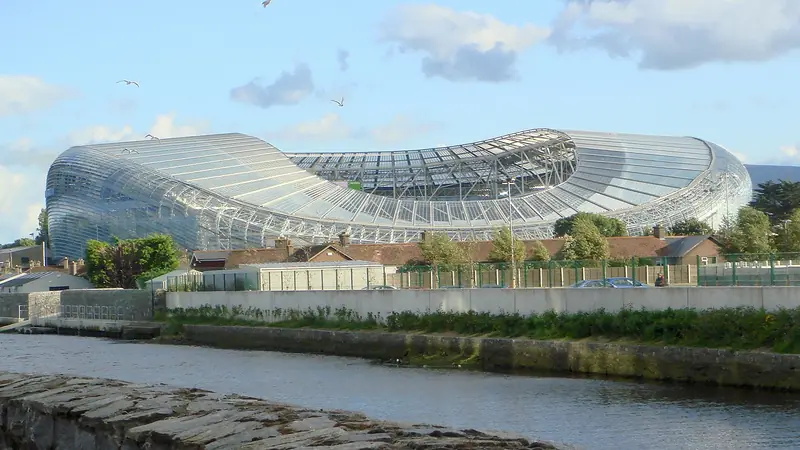
Aviva Stadium’s curved roof rises over Lansdowne Road, where Ireland’s rugby home sits beside the DART railway. The low North Stand and colour-coded approaches make this a ground where your seat and entrance shape the visit.
By Does Your Duck Quack · Updated 14 October 2026
Aviva Stadium at a glance
Sources: Confirmed · Aviva Stadium: A Stadium Built on Greatness · Aviva Stadium Events: Our Location · Aviva Stadium: Contact Us · Irish Rugby: IRFU stadium opening · Aviva Stadium: Stadium lighting installation · Slatterys D4: More Than a Pub, A Dublin Tradition · Checked on 14 October 2026.
Plan your visit
Official tickets and venue informationSome links earn us a small commission at no extra cost to you.
Confirmed · Aviva Stadium: A Stadium Built on Greatness
Before you travel
- Use Lansdowne Road DART for Green or Purple, and Grand Canal Dock for Blue, Orange or Red approaches.
- Follow the venue operator’s one-minute walk from Lansdowne Road, then the ticket’s entrance colour.
- Locate the Sensory Hub at Section 104, East Stand Level 1.
- Bring card payment for Aviva’s bars and food kiosks.
- Return reusable cups to a bar or a dedicated cup bin.
Confirmed · Aviva Stadium: Getting Here - Finding Your Entry Point · Aviva Stadium Events: Our Location · Aviva Stadium: Aviva Sensory Hub · Aviva Stadium: FAQs and Ground Rules · Checked on 14 October 2026.
Lansdowne Road beneath the new stadium
Henry Wallace Dunlop founded the original Lansdowne Road sports ground in 1872, acquiring a 69-year lease from the Pembroke Estates for the Irish Champion Athletic Club. Its early layout included a cinder running track, tennis, croquet, archery and three football pitches.
The first interprovincial rugby match on the ground brought Leinster and Ulster together in 1876. Athletics also belonged to its identity: Ireland met England here in an international meeting in 1875, and later generations saw athletes including Ronnie Delany and Fanny Blankers-Koen. The venue’s own history traces these meetings into the middle of the twentieth century. Rugby’s national home grew out of a shared sporting ground beside the Dodder, with several disciplines occupying the same site.
Ireland first played England at Lansdowne Road on 11 March 1878. When New Zealand visited in 1905, their captain Dave Gallaher was returning to the country of his birth: he came from Donegal. The stadium’s historical gallery records crowds welcoming that touring side from the Belfast train and the two teams subsequently attending a theatre together, sitting in alternating seats. Those early international visits form part of Lansdowne Road’s history well before the familiar modern stands were built.
The rebuilt Aviva Stadium officially opened on 14 May 2010, with Taoiseach Brian Cowen performing the ceremony. The project was jointly undertaken by the Irish Rugby Football Union and Football Association of Ireland, retaining the same site for the national rugby and football teams. Planning approval came in March 2007 and construction activity began that May. The building’s opening and its first sporting event were separate milestones, with spectators entering for matches later in the summer.
The construction project cost €410 million, including €191 million in government funding, according to the IRFU’s opening-day figures. About 6,000 people worked on the development across four million working hours, with a peak workforce of 1,300 people on site in a day. The old ground’s demolition took two months, and 25,000 tonnes of material were reused as fill.
The first rugby game paired a combined Ulster and Leinster side against players from Connacht and Munster in July 2010. Among the young participants who subsequently won Ireland caps were Craig Gilroy, Luke Marshall, Paddy Jackson, Iain Henderson and Martin Moore. Senior international rugby followed in November: South Africa won 23–21, Tommy Bowe scored Ireland’s first try at the new ground and Jonathan Sexton supplied the first Irish points with a penalty. The Springboks’ Juan Smith scored the first international try.
The 2023 Champions Cup final brought 51,711 spectators to the Aviva for La Rochelle’s 27–26 victory over Leinster. Dan Sheehan scored in the opening minute after a break by Jack Conan. Jimmy O’Brien then crossed, and Sheehan’s second try helped Leinster establish a 17–0 lead. La Rochelle recovered through tries from Jonathan Danty and Ulupano Seuteni, with Antoine Hastoy adding kicks. Leinster captain James Ryan left the field injured before half-time. The decisive score came in the 71st minute, when replacement prop Georges-Henri Colombe crossed from close range and Hastoy converted. Leinster’s late pursuit ended with Michael Ala’alatoa sent off for an illegal clearout. La Rochelle retained the trophy, and their captain Grégory Alldritt received the EPCR European Player of the Year award. Leinster had reached the final without losing a game in that season’s competition. Ronan Kelleher was shown a yellow card during the French side’s second-half pressure, and Danty was also sin-binned late on for a high tackle on Caelan Doris.
Ireland secured consecutive Six Nations championships here by beating Scotland 17–13 on 16 March 2024. Tadhg Beirne led the team out on his 50th cap, while Jordan Larmour started after Hugo Keenan withdrew with a hip injury. Dan Sheehan intercepted a wayward Scottish lineout for the first Irish try, converted by Jack Crowley. Scotland stayed within one point at the interval through two Finn Russell penalties. In the second half, the visitors held up Irish attacks on their own line, but Andrew Porter eventually scored from a tap penalty after Ewan Ashman had been sin-binned. Crowley’s conversion made it 17–6. Huw Jones stepped past James Lowe to score Scotland’s late try, with Russell converting. Ireland retained possession through the final passage and kicked the ball into the stands to finish the match. Jamison Gibson-Park was named player of the match. Scotland’s defence made almost three times as many tackles as Ireland’s. Harry Byrne was yellow-carded late in the game for head contact with Russell, leaving Ireland a player down when Jones scored his 17th international try.
Atalanta won their first European trophy at the stadium on 22 May 2024, beating Bayer Leverkusen 3–0 in the Europa League final. Ademola Lookman scored all three goals, becoming the first player to record a hat-trick in that final. His opener came from Davide Zappacosta’s cross in the 12th minute; he added a solo goal in the 26th and finished a Gianluca Scamacca pass in the 75th. The result ended Leverkusen’s 51-match unbeaten run across all competitions. Atalanta coach Gian Piero Gasperini, aged 66, became the oldest Europa League-winning coach. It was the Bergamo club’s first UEFA final, and their first major trophy since the 1963 Coppa Italia. Goalkeeper Juan Musso saved from Alejandro Grimaldo during the first half, while Leverkusen’s Matěj Kovář denied Charles De Ketelaere shortly before the break. Lookman also received UEFA’s player-of-the-match award. Atalanta became the first Italian winners since the tournament adopted the Europa League name; the previous Italian success in the older UEFA Cup had been Parma’s in 1999.
Dublin’s 2011 Europa League final was an all-Portuguese meeting: Porto beat Braga 1–0 on 18 May. Radamel Falcao headed the only goal a minute before half-time, converting a cross from Fredy Guarín. Guarín had intercepted a loose pass from Alberto Rodríguez and advanced before delivering the ball. Falcao’s winner was his 17th goal of that European campaign. Braga introduced Mossoró at half-time, and he almost equalised immediately, but Porto goalkeeper Helton stopped his low shot with a foot. Helton was celebrating his 33rd birthday. The victory made André Villas-Boas the youngest coach to win a UEFA club competition. Porto had previously lifted the UEFA Cup in 2003, while Braga were appearing in their first UEFA club final. Domingos Paciência was managing Braga for the final time. The clubs had already faced each other 131 times before meeting in Dublin. Porto entered as Portuguese league champions, while Braga’s organised defence frustrated both Hulk and Guarín during the first half. Centre-back Kaká was Braga’s other half-time substitution.
Confirmed · Aviva Stadium: History · Aviva Stadium: Stadium historical gallery · Irish Rugby: IRFU stadium opening · Irish Rugby: Aviva Stadium - A Numbers Game · Irish Rugby: Aviva Stadium - Five Years Of Irish Rugby · EPCR: 2023 Champions Cup final · Scottish Rugby: Report: Ireland 17-13 Scotland · UEFA: Atalanta 3-0 Leverkusen: Lookman treble brings UEFA Europa League glory to Bergamo · UEFA: Falcao heads Porto to Europa League glory · Checked on 14 October 2026.
Grand Slams, farewell applause and European finals
Ireland’s first home victory over New Zealand came here on 17 November 2018, when Jacob Stockdale scored the only try in a 16–9 win. The defensive performance mattered as much as the score: the All Blacks were kept to their lowest points total since the 2011 World Cup final. New Zealand’s closing attack reached the Irish 22 before a Brodie Retallick knock-on ended it.
On 18 March 2023, Ireland beat England 29–16 at the Aviva to complete a Six Nations Grand Slam. The IRFU’s match gallery describes a tense first half followed by Ireland pulling clear after the interval, with the home crowd singing The Fields.
Brian O’Driscoll’s last home international took place at the Aviva on 8 March 2014. Ireland beat Italy 46–7 and O’Driscoll received the man-of-the-match award before speaking to reporters at the ground.
The 2013 Heineken Cup final brought two French clubs to Dublin, with Toulon defeating Clermont Auvergne 16–15. Toulon recovered from a nine-point deficit and survived a final-minute David Skrela drop-goal attempt that was charged down.
The roof can become part of the pre-match presentation through a system of 52 colour-changing LED fixtures installed for the 2020 Six Nations. Musco supplied the lighting, with McSherry Electrical handling installation and StadiumFX integrating the controls. The system supports coordinated sound and lighting effects, while mounting points allow temporary moving spotlights to be added.
Confirmed · Irish Rugby: IRFU All Blacks match report · Irish Rugby: IRFU 2023 Grand Slam · Irish Rugby: IRFU O’Driscoll farewell · EPCR: EPCR 2013 final report · Aviva Stadium: Stadium lighting installation · Checked on 14 October 2026.
DART platforms and five different entrance routes
Lansdowne Road DART station sits immediately beside the stadium, and the venue’s meetings-and-events operator gives a one-minute walk from the station to the building. That figure describes proximity to the venue, not the time needed to reach every coloured match entrance. The same operator describes a walking approach from St Stephen’s Green through Merrion Row and Baggot Street Lower towards Lansdowne Road. Its match and concert guidance states that ordinary car and bicycle parking at the stadium is unavailable during those events.
The stadium directs Blue and Orange ticket holders arriving southbound from the city to Grand Canal Dock DART station. From there, the published route turns right onto Barrow Street and continues across the next junction to Shelbourne Road. Blue uses the Shelbourne Road entrance; Orange turns into Lansdowne Lane. Red also starts from Grand Canal Dock, but follows Barrow Street to Grand Canal Street before turning towards Bath Avenue.
Green and Purple routes use Lansdowne Road DART station in the stadium’s city-centre arrival instructions. Green approaches the Lansdowne Road entrance, while Purple continues towards Herbert Road.
Dublin Express identifies route 782 as an airport connection to George’s Quay for Tara Street DART station, followed by a southbound train to Lansdowne Road. Its stadium guide also describes route 785 from Belfast to the Pearse Street and Westland Row area, connecting with Pearse station.
Irish Rail lists Lansdowne Road as a DART and Dublin commuter station with ticket vending machines, smart-card facilities and passenger shelters. It has no station car park, bicycle parking, toilets or refreshments, and the operator says it is not staffed.
Confirmed · Aviva Stadium Events: Our Location · Aviva Stadium: Getting Here - Finding Your Entry Point · Dublin Express: How to Get to Aviva Stadium with Dublin Express · Irish Rail: Lansdowne Road · Checked on 14 October 2026.
Cashless kiosks and the pubs around Beggars Bush
Aviva’s bars and food kiosks are cashless across its events. Public and premium bars use reusable cups without a deposit, and the stadium asks customers to return them to a bar or a dedicated cup-collection bin, rather than placing them in ordinary waste or recycling. Food outlets vary with the event and the levels in use.
Slattery’s stands at 62 Grand Canal Street Upper, Beggars Bush, Dublin D04 T295. The pub dates its quiet opening to a Friday in November 1989, immediately before Ireland faced New Zealand and Willie Anderson led his side towards the haka. It describes five separate bar areas and a longstanding family connection with Slattery’s in Rathmines. Its location places it in the Grand Canal Dock and Beggars Bush part of the stadium neighbourhood, rather than on the Herbert Road approach.
Slattery’s advertises rugby coverage from the United Rugby Championship and Champions Cup, alongside football, Gaelic games, golf and other major sporting events. Its sports page specifically offers pints and pizza and provides a table-booking route for larger groups.
The Bath Pub opened in February 2012 on Bath Avenue and underwent a major refurbishment in 2019. Its interior has two large rooms served by one bar, with a south-facing courtyard outside. The pub’s own description highlights its pizza oven, craft beers and whiskey selection.
The stadium’s sustainability statement says the protein and dairy products sold inside are sourced within Ireland. It also describes salads, seafood and water options as part of its catering provision, without promising a fixed menu at every kiosk. The same statement records local and national procurement through centralised distribution.
Our pick (opinion): Slattery’s would be our choice for a pub stop around Beggars Bush, particularly if its pints-and-pizza offer fits the meal you want before the rugby.
Confirmed · Aviva Stadium: FAQs and Ground Rules · Slatterys D4: More Than a Pub, A Dublin Tradition · Slatterys D4: Slattery’s sport and food · The Bath Pub: About Us · Aviva Stadium: Stadium sustainability · Checked on 14 October 2026.
The low north end and the shape of the roof
Populous designed the stadium’s curved form around an unusually constrained site. Housing to the north and south, neighbours’ rights to light and the adjacent railway shaped the enclosure. The building rises along its long sides and falls towards the ends, producing the dipped silhouette visible from surrounding streets. Its transparent polycarbonate louvres and glass reflect changing daylight.
The North Stand is the conspicuous exception to the stadium’s taller sides: it has only the lower tier because of the housing beyond it. On the other three sides, the historical gallery describes four levels, with general seating in the lower and upper areas and premium or corporate accommodation between. This is the central visual difference between ends when looking across the pitch. A North Stand seat sits within the low part of the bowl, rather than beneath another full-height bank of spectators.
The Blue route serves the west side across all levels, while Orange serves west-side Level 1 through Lansdowne Lane. Green reaches all levels on the south side from Lansdowne Road. Red is associated with the north and east sides on Levels 1 and 5, approached from Bath Avenue; Purple serves the east side through Herbert Road across all levels. These are the stadium’s published allocations, making the colour on a ticket useful for understanding both its street entrance and its position in the building.
At the time of completion, the IRFU recorded the stadium’s height as 47.65 metres and its roof area as approximately 19,000 square metres. The façade used 4,251 polycarbonate panels. The project occupied a site of about 6.4 hectares, so the visible roof and skin were fitted into a comparatively tight urban footprint.
A new Hero Hybrid playing surface made its match debut on 5 August 2026 for Arsenal against Real Betis. The stadium says the replacement reduced the recovery period after concerts from a minimum of six weeks under the previous system to around two weeks. Turf was grown at Croke Park Turf Farm in the Naul and installed in numbered rolls. The pitch also uses roof-harvested rainwater stored in basement tanks and pumped into the irrigation system, linking the building’s large roof to grounds maintenance.
The principal roof structure uses a horseshoe-shaped truss supported by two columns at the north end. Populous describes a shared three-dimensional design model that coordinated the architects, engineers and contractors, helping align the structure and external cladding. The northern dip is therefore reflected in the roof engineering as well as the seating. The design process also had to accommodate the railway, with demolition and construction arranged to limit interruptions to train services beside the site.
The roof uses Palram’s SUNTUF corrugated polycarbonate sheets across a skylight area of 20,000 square metres. The manufacturer supplied clear and matt panels in its 8290 profile, each three millimetres thick. Its project account describes a change from the original proposal for eight-millimetre solid panels. The corrugated sheets were installed across the roof’s slope, following the stadium’s wave-shaped outline. Each panel was cut individually and marked so that installers could identify its exact position. Clear panels transmitted 86 per cent of the light, while the matt version transmitted 84 per cent. Palram produced the sheets at its Australian factory for the stadium’s 2010 opening. The panel profiles were shaped to match the façade and walls. HOK Sport, subsequently known as Populous, specified the material for the skylight. The manufacturer’s engineering account identifies the roof’s elliptical form and thin corrugated sheets as central elements of the completed design.
Our advice (opinion): We would compare the North Stand with a long-side seat before booking: its single lower tier gives it a distinctly different setting from the taller sides.
Confirmed · Populous: Populous stadium architecture · Aviva Stadium: Stadium historical gallery · Aviva Stadium: Getting Here - Finding Your Seat · Irish Rugby: Aviva Stadium - A Numbers Game · Aviva Stadium: Aviva Stadium’s New ‘Lay and Play’ Pitch Transforms Stadium Flexibility · Palram: Aviva Stadium, Ireland · Checked on 14 October 2026.
Five accessible entrances and the East Stand sensory hub
Aviva lists five dedicated accessible entrances: E for the Lower West Stand, X for the Upper West Stand, A for the South Stand, M for the East Stand and I for the North Stand. They are served by lifts and available to wheelchair users, people using mobility aids and spectators with reduced mobility. The ground publishes 230 wheelchair places and an equal number of personal-assistant positions across its levels, so accessible viewing is distributed around the stadium rather than concentrated at one end.
The stadium lists 51 accessible toilets near viewing areas and lowered sections at bar and food counters throughout the concourses. Tactile flooring identifies the top and bottom of stair flights. Assistance dogs are permitted, with requirements discussed with the event organiser before booking.
The Aviva Sensory Hub opened in 2020 and is located at Section 104 on Level 1 of the East Stand. It includes a Cubbie booth that can adjust its multisensory environment to an individual visitor’s needs. A profile created during an initial visit can be used again, and the facility is described as free for people attending stadium events.
At Lansdowne Road station, Irish Rail identifies level access to Platform 1 for northbound trains towards the city and a ramp-and-gate route to southbound Platform 2. It lists no accessible toilet or wheelchair loan facility. Passengers needing help boarding a train must arrange assistance before travelling through the operator’s accessibility service.
Confirmed · Aviva Stadium: Stadium accessibility · Aviva Stadium: Aviva Sensory Hub · Irish Rail: Lansdowne Road · Checked on 14 October 2026.
A hotel assembled from Herbert Road houses
The Sandymount Hotel began in 1955 when George and Rosaleen Loughran opened a bed and breakfast on Herbert Road. The family expanded by buying neighbouring properties, gradually joining the Victorian terrace into a larger hotel. The bricks used for the houses in 1866 had come from an earlier distillery on the site.
The property formerly traded as the Mount Herbert Hotel before taking the Sandymount name in 2011. Its history describes the commissioned Sandymount Lineout bronze rugby sculpture outside, linking the hotel visually with its stadium neighbour. The public address is Herbert Road, Dublin D04 VN88.
The Sandymount Hotel’s match-day page presents accommodation, food and drink for Ireland rugby visitors and identifies Lansdowne Road DART station as a five-minute walk from the property, with the Aviva closer still.
The hotel’s resident information explicitly directs guests to Lansdowne Road station, not Sandymount station, and places it at the Aviva approximately 200 metres from the hotel.
Confirmed · Sandymount Hotel: Our History · Sandymount Hotel: Rugby Match Days · Sandymount Hotel: The Sandymount Hotel · Checked on 14 October 2026.
Tours, tickets and the modern stadium’s identity
Public stadium tours are closed, and Aviva’s contact page says they will remain closed for the foreseeable future. The same page gives the full venue address as Aviva Stadium, Lansdowne Road, Ballsbridge, Dublin 4, D04 K5F9. Tickets and hospitality are distributed by the relevant event organiser rather than the stadium office itself, with separate contacts for IRFU rugby, FAI football and Leinster fixtures.
The stadium’s current public homepage gives a capacity of 51,711.
The published bag rule permits only small handbags no larger than A4, and the stadium does not admit buggies, strollers or prams. Umbrellas cannot be used inside. Small cameras are permitted for football and rugby, but lenses larger than 70mm are excluded. These are specific Aviva admission conditions, with concert photography governed by the relevant event information.
Explore the RDS Arena, Thomond Park and the Six Nations.
Confirmed · Aviva Stadium: Contact Us · Aviva Stadium: A Stadium Built on Greatness · Aviva Stadium: FAQs and Ground Rules · Checked on 14 October 2026.
Choose your overnight base
Some links earn us a small commission at no extra cost to you.