 Off to the Rugby
Rugby union
Stadio Olimpico
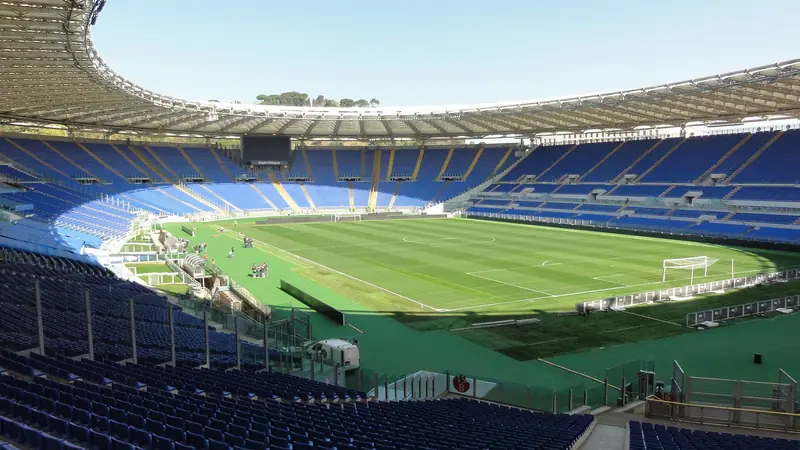
Italy’s home rugby internationals take place at Rome’s Stadio Olimpico, inside the Foro Italico complex. The athletics track, Monte Mario backdrop and route through the city’s northern districts make this a distinctive Six Nations trip.
By Does Your Duck Quack · Updated 14 October 2026
Stadio Olimpico at a glance
Sources: Confirmed · Atac: Tram network service changes · Roma Mobilità: #RomaGiocaSostenibile al Sei Nazioni Maschile 2026 - Roma Servizi per la Mobilità · Italian Rugby Federation: FIR stadium visitor information · Turismo Roma: Stadio Olimpico · Sport e Salute: FAQ - Sport e Salute S.p.A. · Roma Beer Company: Roma Beer Company – Ponte Milvio – La Birra Ha trovato casa · AS Roma: Seating plan · Checked on 14 October 2026.
Plan your visit
Official tickets and venue informationSome links earn us a small commission at no extra cost to you.
Confirmed · Sport e Salute: Official visitor information
Before you travel
- Follow the ten-minute Mancini walk across Ponte Duca d’Aosta.
- Check line 2 replacement-bus boarding points; October 2026 buses leave Flaminio from the line 490 stop.
- Request the Termini accessible transfer from FIR in advance if required.
- Use Monte Mario on Viale dei Gladiatori for a separately booked non-match-day tour.
- Locate Roma Beer Company at Piazzale di Ponte Milvio 40/42 if meeting north of the ground.
Confirmed · Roma Mobilità: #RomaGiocaSostenibile al Sei Nazioni Maschile 2026 - Roma Servizi per la Mobilità · Atac: Tram network service changes · Italian Rugby Federation: FIR accessible match services · Sport e Salute: Info and tickets · Roma Beer Company: Roma Beer Company – Ponte Milvio – La Birra Ha trovato casa · Checked on 14 October 2026.
From the Cypress Stadium to an Olympic landmark
Enrico Del Debbio drew the first stadium project in 1927, and the initial structure opened partially in 1932 as the Stadio dei Cipressi, or Cypress Stadium. Work stopped during the Second World War, when the site was subsequently used to park Allied vehicles. Construction resumed in 1950. The completed stadium opened on 17 May 1953 with Italy playing Hungary at football. Its enormous original accommodation prompted the nickname Stadio dei Centomila, the stadium of one hundred thousand.
The 1960 Olympic Games brought a reduced capacity and the name Stadio Olimpico. Later major alterations prepared the ground for the 1990 football World Cup, followed by further work in 2007 to meet UEFA requirements. AS Roma and SS Lazio use it for home football matches, while Italy’s Six Nations internationals arrived in 2012. The venue’s wider programme has included the Golden Gala athletics meeting and concerts by artists such as Miles Davis, David Bowie, Tina Turner and U2.
The stadium belongs to the Foro Italico complex, originally developed under Mussolini as a centre for physical education and sport. The site opened in 1932 under its earlier name, Foro Mussolini. Piazza Lauro de Bosis contains the obelisk designed by Costantino Costantini, whose inscription still names Mussolini. The former academy building now associated with CONI dates from 1928–1932. These surviving architectural features place the rugby venue within a particular period of Italian political and sporting history.
Annibale Vitellozzi’s completed stadium used a concentric bowl, subsequently altered substantially for the 1990 World Cup. UEFA’s architectural history describes the ends being brought closer to the playing field, expansion of the Tevere and Monte Mario stands, and the installation of a new roof. The redevelopment also added basement parking and new media and ceremonial facilities.
The Olimpico staged both matches required to settle the 1968 European Championship final. Italy and Yugoslavia first drew 1–1; the replay two days later ended in a 2–0 Italian victory. That unusual two-match conclusion belongs to an era before today’s penalty-shootout procedure settled such finals.
Dragan Džajić put Yugoslavia ahead in the first 1968 final, and Angelo Domenghini equalised with ten minutes remaining. Italy coach Ferruccio Valcareggi changed his team for the replay, bringing in Sandro Mazzola and Luigi Riva. Riva and Pietro Anastasi scored the goals that secured the trophy. Goalkeeper Dino Zoff later acknowledged that Italy had been fortunate to draw the first encounter, while judging the replay victory deserved. The two Olimpico matches produced markedly different Italian performances.
Italy’s first Six Nations season at the Olimpico ended with a 13–6 win over Scotland on 17 March 2012. Mirco Bergamasco and Greig Laidlaw exchanged first-half penalties, leaving the score level at the interval. Nick De Luca was sin-binned shortly before the break, and Italy exploited the extra man after restarting: Giovanbattista Venditti scored on the left, with Kristopher Burton converting. Scotland later lost Jim Hamilton to a yellow card, while Alessandro Zanni was also sent to the sin bin for Italy. Burton’s late drop goal made the margin seven points. Scotland’s lineout repeatedly failed to secure possession despite a competitive scrum, and their final attacks produced no try. Jon Welsh made his Scotland debut after Allan Jacobsen was injured during the warm-up. The result left Scotland at the bottom of the table and gave the new Italian national rugby venue its first championship victory.
Luciano Orquera created both Italian tries in the 23–18 victory over France on 3 February 2013. His early midfield break released Sergio Parisse for the opening score; after France recovered to lead 18–13, his close-range offload put Martin Castrogiovanni over. Orquera contributed ten points with the boot through two conversions, a penalty and a drop goal. Replacement fly-half Kristopher Burton added another drop goal to extend Italy’s lead to five. France had scored through Louis Picamoles and Benjamin Fall and led 15–13 at half-time, but their late pressure failed to produce a winning try. Two attacking scrums offered a final opportunity before Fall was forced into touch. Sky Sports recorded 67,529 spectators for the match, which returned the Giuseppe Garibaldi Trophy contest to Italy’s favour after France had won the previous year.
Confirmed · Turismo Roma: Stadio Olimpico · Turismo Roma: The Foro Italico Complex · UEFA: Stadio Olimpico · UEFA: Italy make most of good fortune · Scottish Rugby: Italy 13-6 Scotland · Reported · Sky Sports: Italy 23 - 18 France - Match Report & Highlights · Checked on 14 October 2026.
The afternoon Italy finally beat England
Italy defeated England for the first time on 7 March 2026, winning 23–18 at the Olimpico. Leonardo Marin’s decisive try followed the attacking work of Monty Ioane and Tommaso Menoncello.
FIR recorded 68,245 spectators for the 2026 Scotland match and 68,985 for England, a combined attendance of 137,230 across the two home internationals. The federation described that total as approximately ninety-nine per cent of the available accommodation.
On 9 March 2024, Italy beat Scotland 31–29 here after trailing 22–16 at half-time. Louis Lynagh scored on debut following Paolo Garbisi’s kick, and Stephen Varney crossed after a break by Ross Vintcent. Garbisi’s late penalty made the margin nine points before Sam Skinner’s converted try brought Scotland back within two. Italy then resisted the final attack. The victory was Gonzalo Quesada’s first as Italy coach and ended the long wait for another Six Nations win in Rome.
Italy’s 22–15 victory over Ireland in 2013 was their first against that opponent in the Six Nations. It completed a championship in which Italy also beat France at home and finished fourth in the table.
For the March 2026 England fixture, the Peroni Nastro Azzurro Terzo Tempo Village occupied the Foro Italico with entertainment, partner activities and screens showing Scotland against France. FIR’s programme named Radio Deejay, M2O and Radio Capital, with performers including Davide Rizzi, Vittoria Hyde and Mario Fargetta.
The 2026 Scotland match unfolded in heavy rain, with Italy establishing a 12–0 lead through Louis Lynagh and Tommaso Menoncello. Lynagh chased Juan Ignacio Brex’s kick for the opening try; for the second, he won an aerial contest before Michele Lamaro released Menoncello. Jack Dempsey replied for Scotland, but Paolo Garbisi’s penalty left Italy 15–7 ahead at half-time. Finn Russell and Garbisi exchanged penalties after the interval. George Horne then scored from the base of a maul, reducing the gap to three points, but Russell missed the conversion. Italy’s scrum continued to win penalties even after the replacement front row entered. Tighthead Simone Ferrari was named player of the match. The closing Scottish attack lasted more than twenty phases without breaking the home defence, preserving an 18–15 result in front of 68,245 spectators.
France scored eleven tries in their 73–24 win at the Olimpico on 23 February 2025. Italy had started brightly, Tommaso Menoncello scoring after a break through midfield and Tommaso Allan adding the conversion. The home side later moved 10–7 ahead, but French scores through Peato Mauvaka and Antoine Dupont changed the lead. Juan Ignacio Brex replied after Ange Capuozzo’s break and Federico Ruzza’s offload, keeping Italy within four points before France pulled away to 35–17 at the interval. Grégory Alldritt scored early in the second half and Dupont added another try. Paolo Garbisi crossed from a scrum move for Italy’s third, but France continued scoring through the closing minutes, with Théo Attissogbé and Pierre-Louis Barassi among the finishers. The result established France’s highest score in the Six Nations at that time.
Confirmed · Italian Rugby Federation: FIR first England victory · Italian Rugby Federation: FIR 2026 crowd totals · Six Nations Rugby: Italy v Scotland Rugby Fixtures · Six Nations Rugby: Classic Guinness Six Nations Moment: Italy 22-15 Ireland - Guinness Men's Six Nations · Italian Rugby Federation: FIR March 2026 entertainment · Italian Rugby Federation: FIR 2026 Scotland match report · Six Nations Rugby: Italy v France · Checked on 14 October 2026.
Mancini, Ponte Duca d’Aosta and the line 2 replacement
Roma Mobilità’s 2026 Six Nations guide sends passengers from Termini along Metro A towards Battistini, changing at Flaminio for the line 2 corridor to Mancini. From Mancini it gives a ten-minute walk across Ponte Duca d’Aosta to the stadium. Its other route uses Metro A to Ottaviano and bus 32 from Via Barletta to De Bosis, followed by a five-minute walk.
ATAC’s October 2026 works notice states that line 2 remains fully replaced by buses throughout the day. Towards Mancini, replacement buses leave Piazzale Flaminio from the line 490 stop and use Lungotevere Thaon di Revel instead of Viale Pinturicchio. Returning towards Flaminio, they depart from the bus terminus at Piazza Mancini. ATAC also places the return replacement stop on Via Flaminia near Piazza dei Carracci, shared with route N201, instead of the usual Via Masaccio stop.
The tour operator gives another precise approach from Ottaviano: bus 32 towards Saxa Rubra to Lungotevere Cadorna/Ostello Gioventù, then Via Roberto Morra di Lavriano towards Viale dei Gladiatori. From Lepanto, bus 301 towards Grottarossa serves the same riverside stop. The published directions also identify bus 69 from Campi Sportivi and bus 168 to Largo Maresciallo Diaz/Bosis.
The city’s rugby mobility plan identifies bicycle parking on Via Franchetti and Via Nigra, with a cycling approach along Capoprati and the river. It also names taxi collection areas around Via Antonino da San Giuliano, Ponte Duca d’Aosta and Lungotevere Maresciallo Cadorna. For eligible disabled spectators, the plan distinguishes accredited parking around Farnesina and Via Nigra from the Viale Alberto Blanc provision.
AS Roma’s stadium guide places taxi options beyond several different exits: De Bosis and Dodi lead towards Piazzale Maresciallo Diaz, while Gladiatori and Olimpiadi lead towards Piazzale Maresciallo Giardino. It also identifies Piazza Gentile da Fabriano across Ponte della Musica. The club lists cycle parking on Via Franchetti by the Stadio dei Marmi.
Confirmed · Roma Mobilità: #RomaGiocaSostenibile al Sei Nazioni Maschile 2026 - Roma Servizi per la Mobilità · Atac: Tram network service changes · Sport e Salute: Info and tickets · AS Roma: Stadio Olimpico · Checked on 14 October 2026.
A Foro Italico village and Ponte Milvio beer stop
Roma Beer Company’s Ponte Milvio premises are at Piazzale di Ponte Milvio 40/42, 00135 Roma. The business advertises thirteen draught beers, around 150 bottled labels, wine and food, with outdoor tables and Wi-Fi.
Gold Open Bistro is inside the Monte Mario side of the stadium, in the Gold room, with a dedicated terrace and screens. Sport e Salute gives its address as Viale dei Gladiatori 2 and describes a space accommodating up to 120 guests. The venue offers food, aperitifs and private-event arrangements. It is also associated with the stadium tour route. Access to this internal bistro is a separate arrangement from choosing an ordinary seat for a rugby international.
FIR’s 2026 partnership with Equoevento collects surplus food from stadium hospitality areas and the village food outlets after matches, passing it to charitable organisations. The federation reported around 430 portions, approximately sixty-five kilograms of food, recovered after the February Scotland fixture.
FIR’s stadium information prohibits glass containers, cans and pets, while allowing pocket-sized umbrellas. It also directs spectators needing luggage storage to an external partner, Radical Storage.
The March 2026 village programme included UNICEF representatives supporting the Una Meta per il Futuro campaign. FIR also announced a mobile cardiovascular-prevention clinic from Fondazione Progetti del Cuore and screening by Policlinico Gemelli. The Gemelli service was located on the ground floor of the Foro Italico’s main tennis stadium, on the Viale delle Olimpiadi side, and assessed risk factors, muscle mass and cognitive performance. These health activities accompanied the England international.
Confirmed · Roma Beer Company: Roma Beer Company – Ponte Milvio – La Birra Ha trovato casa · Sport e Salute: Gold Bistro · Italian Rugby Federation: FIR 2026 social initiatives · Italian Rugby Federation: FIR stadium visitor information · Checked on 14 October 2026.
Monte Mario, Tevere and the athletics bowl
UEFA records European Cup finals at the Olimpico in 1977 and 1984, both won by Liverpool, and in 1996, won by Juventus. The stadium also hosted the 1987 World Athletics Championships and the 1990 World Cup final.
Beside the main stadium, the Stadio dei Marmi is enclosed by sixty statues donated by Italian cities. Rome’s tourism authority records that the athletics ground took Pietro Mennea’s name in 2013.
Preparations for the 2024 European Athletics Championships included a newly laid track at the Olimpico. European Athletics used the stadium to unveil the championship medals one month before the meeting, connecting the arena’s modern programme with its long track-and-field history.
The rugby federation sells the Olimpico through eight stadium sectors and identifies the ground as Italy’s Six Nations home since 2012. Its own operating address is in the Curva Nord at the Foro Italico, postcode 00135 Roma.
The 1990 roof was designed by Massimo Majowiecki’s engineering practice for CONI. Its structural system uses eighty-eight radial cable assemblies spaced at twelve-metre intervals. Each assembly combines load-bearing and stabilising cables with vertical stays. Around the outside, the cables connect to a compression ring; towards the pitch, they attach to a tension ring. Secondary radial trusses support a membrane made from PTFE and fibreglass. The engineer’s project record gives a covered surface of fifty thousand square metres. The roof’s load is consequently carried through a linked system of rings, cables and secondary beams, leaving the large opening above the playing field. The practice’s published technical work covers the original suspended-roof design, its response to wind and later structural maintenance.
Confirmed · UEFA: Stadio Olimpico · Turismo Roma: The Foro Italico Complex · European Athletics: European Athletics Rome preparations · Italian Rugby Federation: FIR stadium visitor information · Majowiecki: Roof engineering project · Checked on 14 October 2026.
A Monte Mario Quiet Room and assisted arrivals
FIR’s current accessibility programme lists three electric golf cars operating within the Foro Italico and assistance for spectators using wheelchairs. An accessible vehicle, provided through Arvalia, connects Termini with the stadium by advance request through accoglienzadisabili@federugby.it.
Accessible accreditation is handled by the federation, with supporting disability documentation and companion eligibility considered through its application process. Places are limited and confirmation is required; submitting a request is not the same as receiving a ticket. FIR identifies its Quiet Room in Monte Mario Sky Box 8, giving the service a specific location within the stadium.
The Quiet Room programme began in 2025 for children with autism and developed from rugby-and-autism work involving Primavera Rugby, Ali dei Pesci and Astuti Macerata. FIR’s published programme describes a room with a total limit of fourteen people and applications through the social-responsibility team.
FIR introduced professional audio description in 2025 with Connect Me Too and CMT Translations. The commentary describes action on the field as well as relevant activity on the benches and in the stands, using a digital connection over 4G or 5G. Blind and partially sighted supporters can request the service themselves or through a companion, and it is also available for listening from home.
For the England match in March 2026, FIR announced that Bianca Bifano and Chiara Vecchione Foa from Rome’s Coro delle Mani Bianche would interpret the two national anthems in sign language alongside the singers. The same programme included dedicated disability sectors, accompaniment, the Quiet Room and audio description.
The Quiet Room application route is responsibilitasociale@federugby.it. FIR’s current programme allows applications for minors with autism through participating club projects, with up to four accompanying people specified in its conditions. The room’s fourteen-person total includes companions, making the application and allocation process part of the service. The programme links the national-team visit with existing rugby-and-autism activity undertaken by the named partner clubs.
Confirmed · Italian Rugby Federation: FIR accessible match services · Italian Rugby Federation: FIR Quiet Room programme · Italian Rugby Federation: FIR audio-description service · Italian Rugby Federation: FIR 2026 social initiatives · Checked on 14 October 2026.
A Flaminio base and the old Milvian Bridge
River Palace Hotel gives its address as Via Flaminia 33, 00196 Roma, close to Flaminio, Piazza del Popolo and Villa Borghese. That location places a visitor near the city end of the line 2 stadium corridor rather than beside the Olimpico itself.
The River Palace describes seventy-two rooms and a separate Michelangelo Court accommodation area opened in 2017. Twelve rooms in that courtyard arrangement occupy two levels, while the main building and courtyard have different room categories. The published room description includes marble bathrooms and mosaic details. Its main building offers seven room types, while the courtyard has four.
The main building’s seven categories are Single, Smart, Classic, Family, Deluxe, Prestige and Suite Villa Borghese. Michelangelo Court has four different categories: Premium Central Court, Deluxe Central Court, Junior Suite Central Court and Suite Giulio Cesare. The hotel specifies cotton-satin sheets, pillow-top bedding, a minibar and flat-screen satellite television in its room description. Bathrooms use marble and mosaic finishes with Ortigia toiletries. The courtyard accommodation occupies a separate internal setting created during the 2017 expansion.
Ponte Milvio gives the neighbourhood north of the stadium a much older landmark. Rome’s tourism authority dates the ancient bridge to 109 BC and associates its construction with Marcus Aemilius Scaurus. The tower at its northern end was redesigned by Giuseppe Valadier in 1805 under Pope Pius VII.
Ponte Milvio is now a pedestrian crossing, with only three central arches surviving from the ancient structure. Its history includes the battle between Constantine and Maxentius in AD 312 and damage inflicted in 1849 when Garibaldi sought to delay French troops; restoration followed in 1850. Modern work has also changed its evening appearance: ACEA installed sixteen energy-saving LED projectors to illuminate the Valadier tower in 2021. The crossing combines ancient remains, nineteenth-century reconstruction and a recent lighting scheme.
River Palace’s Deluxe rooms have either a double bed or two single beds. Their published facilities include air conditioning, a safe, satellite television, Wi-Fi and a towel warmer, together with bathrobes and slippers. The room specification also lists natural light, a hairdryer, bath amenities, a telephone and a smoke detector. Room service and a wake-up service are available through the hotel. The Deluxe category belongs to the main building, distinct from the separately listed Deluxe Central Court accommodation.
Our pick (opinion): For a stay tied to the Flaminio end of the journey, we would consider River Palace’s Via Flaminia location; it suits a plan built around Piazza del Popolo.
Confirmed · River Palace Hotel: Where we are · River Palace Hotel: River Palace rooms · Turismo Roma: Ponte Milvio and the Torretta Valadier · River Palace Hotel: Discover the Deluxe room of River Palace Hotel in Rome center · Checked on 14 October 2026.
Rugby memorabilia on the official stadium tour
The official tour’s rugby collection includes Antonio Pavanello’s shirt, Mauro Bergamasco’s boots, Marco Bortolami’s shirt and a match ball from Italy against Ireland in 2015. Those objects make rugby part of a route otherwise shared with the stadium’s football and Olympic stories.
The tour enters through Monte Mario and proceeds through the Tunnel of Legends, mixed zone and dressing-room areas associated with Roma, Lazio and the Italian football team. A historical timeline and a multi-screen display accompany the route before the player entrance and technical area beside the field. The operator also includes the store and Gold Open Bistro in the visitor sequence.
Sport e Salute describes the guided tour as lasting around forty to forty-five minutes. Visitors can enter the technical area and artificial-turf strip in front of the benches, but cannot walk on the natural-grass playing surface. The meeting point is the Monte Mario vehicle entrance on Viale dei Gladiatori.
Official tour bookings are handled through Vivaticket, with an on-site ticket office identified at Via dei Gladiatori 2. The tour does not operate on match days, so it is a separate activity to place on another part of a Rome stay.
Continue with Benetton in Treviso, the Six Nations and rugby accommodation.
The Tunnel of Legends display extends beyond rugby: the operator names memorabilia associated with Francesco Totti, Daniele De Rossi, Giorgio Chinaglia and Ciro Immobile, alongside Olympic sprinter Livio Berruti and football internationals Dino Zoff and Giorgio Chiellini. Light and audio installations accompany the tunnel. In the mixed-zone section, a ten-screen display presents stadium history and visitors can use QR codes with the tour app. A press-conference backdrop provides another stop before the dressing rooms and player entrance.
Our advice (opinion): We would put the Olimpico tour on a separate day from the match, giving the football and rugby memorabilia room to become part of the Rome visit.
Confirmed · Sport e Salute: The path - Sport e Salute S.p.A. · Sport e Salute: FAQ - Sport e Salute S.p.A. · Sport e Salute: Info and tickets · Checked on 14 October 2026.
Choose your overnight base
Some links earn us a small commission at no extra cost to you.